

Peter Lynch and Safra Catz never crossed paths professionally, and no record links their careers directly.
What ties them together is simpler. Both shaped how the business world thinks about money one from Wall Street, the other from the boardroom.
Peter Lynch turned the Fidelity Magellan Fund into a household name through patient, disciplined stock picking. Safra Catz climbed Wall Street’s investment banking ranks before leading Oracle Corporation as CEO for over a decade.
One mastered public markets from the outside. The other reshaped a tech giant from deep inside its walls.
Their paths rarely cross in headlines, yet both prove one thing. Sharp judgment and steady patience win over decades, not single quarters.
This piece traces both journeys — from modest beginnings to boardroom power. It shows exactly what separates an investing legend from a corporate powerhouse.
Quick Comparison
| Aspect | Peter Lynch | Safra Catz |
| Born | January 19, 1944, Newton, Massachusetts | December 1961, Holon, Israel |
| Education | Boston College (BS); Wharton School, MBA (1968) | Wharton School, BS (1983); Penn Law, JD (1986) |
| Early Career | Fidelity intern (1966); U.S. Army lieutenant, Korea | Investment banker at Donaldson, Lufkin & Jenrette |
| Joined Key Company | Fidelity Investments, 1969 | Oracle Corporation, 1999 |
| Signature Role | Manager, Fidelity Magellan Fund (1977–1990) | CEO, Oracle (2019–2025); now Executive Vice Chair |
| Career Peak Achievement | Grew Magellan from $18M to $14B, 29.2% avg. annual return | Led Oracle’s $9.3B NetSuite acquisition (2016) |
| Known For | “Invest in what you know,” PEG ratio, tenbaggers | Cost discipline, aggressive cloud strategy, M&A execution |
| Books | One Up on Wall Street, Beating the Street, Learn to Earn | None published |
| Net Worth | Not publicly disclosed; wealth tied to Magellan-era earnings | Estimated above $3 billion (Oracle equity) |
| Philanthropy | The Lynch Foundation (education, healthcare, Boston area) | Oracle Education Foundation; Homeland Security Advisory Council |
| Industry | Investment management / mutual funds | Enterprise technology / cloud software |
Early Life & Background
Peter Lynch’s Roots
Peter Lynch grew up in Newton, Massachusetts, after losing his father at just ten years old.
His father, a mathematics professor, died of cancer when Lynch was still a boy. The loss forced his mother into the workforce to support the family.
To help out, young Lynch started caddying at Brae Burn Country Club. Carrying golf bags for local businessmen taught him more than pocket change ever could.
He listened closely as executives discussed stocks between holes. Those quiet conversations planted the seed for his lifelong obsession with the market.
Lynch’s caddying earned him a scholarship that later opened the door to Boston College.
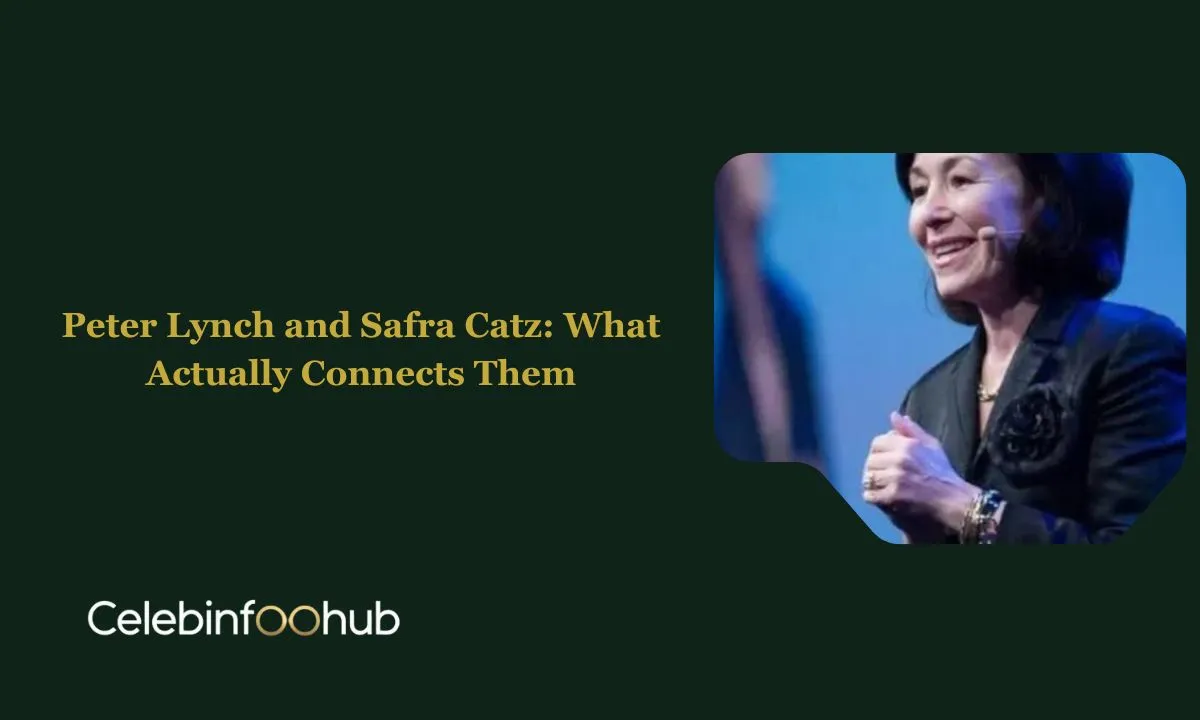
Safra Catz’s Roots
Safra Catz was born in Holon, Israel, in 1961, before her family immigrated to America when she was just six.
The Catz family settled in Brookline, Massachusetts, after leaving Israel. Her father worked as a physicist while her mother had survived the Holocaust.
Safra later graduated from Brookline High School, a public school in that same suburb. That early move shaped a fierce, adaptable, immigrant work ethic in her.
She carried that same hustle into every job that followed. It became her trademark decades later inside Oracle’s boardroom.
Education
Peter Lynch’s Education
Peter Lynch studied at Boston College before earning his MBA from Wharton.
He paid his way through college using caddy earnings and his caddie scholarship. The very job that shaped his thinking also funded his degree.
During his sophomore year, Lynch made his first stock purchase: 100 shares of Flying Tiger Airlines at $7 apiece. The stock later climbed to $80 a share, and those profits helped cover his tuition.
Lynch then enrolled at the Wharton School at the University of Pennsylvania, graduating with the class of 1968. Business fundamentals learned there shaped his stock-picking style for the rest of his career.
Safra Catz’s Education
Safra Catz earned her undergraduate degree from Wharton in 1983, then stayed at Penn for law school.
She completed her University of Pennsylvania studies, then moved straight into University of Pennsylvania Law School. A Juris Doctor gave her a legal foundation most tech executives never build.
That legal training later sharpened her instincts in mergers and acquisitions. Few major Oracle deals ever moved forward without her direct review.
Career Beginnings
Peter Lynch — Fidelity Entry
Peter Lynch joined Fidelity Investments as an intern in 1966, fresh out of college.
He spent that summer researching companies most analysts overlooked. Mentor George Sullivan, then Fidelity’s president, noticed his sharp eye and pushed him toward deeper stock analysis.
Military service pulled Lynch away soon after. He served as a lieutenant in the U.S. Army for two years, stationed in South Korea.
Fidelity welcomed him back in 1969 as a full-time research analyst. That role gave him direct exposure to hundreds of companies across every sector.
Years of grinding through earnings reports built the foundation for what came next.
Safra Catz — Wall Street Entry
Safra Catz started her career at Donaldson, Lufkin & Jenrette, a respected New York investment bank.
She rose quickly through the ranks there, eventually reaching Managing Director. Investment banking sharpened her deal instincts long before Oracle ever entered the picture.
Her focus centered on mergers and acquisitions work. That specialty became her calling card for the rest of her career.
DLJ gave Catz something rare: real deal-execution experience under pressure. That experience later defined how she ran Oracle’s biggest acquisitions.
Rise to Prominence
Lynch and the Magellan Fund
Peter Lynch took over the Fidelity Magellan Fund in 1977, managing just $18 million in assets.
By the time he stepped down in 1990, that number had exploded past $14 billion. Few fund managers in history have matched that kind of growth.
His average annual return hit an astonishing 29.2 percent during those thirteen years. That figure still gets cited as a benchmark across the fund management industry.
Lynch coined the term “tenbagger” for stocks that grew tenfold in value. His first tenbagger came from an unlikely place — a fast-food chain called Taco Bell.
He also created the PEG ratio, a simple valuation shortcut still used by investors today.
- Took Magellan from $18 million to $14 billion in assets
- Delivered a 29.2% average annual return over 13 years
- Outpaced the S&P 500 consistently through the 1980s
- Coined “tenbagger” — first spotted in Taco Bell — and created the PEG ratio
Catz’s Rise at Oracle
Safra Catz joined Oracle Corporation in 1999, brought in by founder Larry Ellison himself.
She rose fast, becoming Executive Vice President within months and joining Oracle’s board in 2001. Oracle named her President in January 2004.
The CFO title came later — she held it on an interim basis, then permanently from 2011 onward. Oracle named her Co-CEO alongside Mark Hurd in September 2014.
When Hurd passed away in 2019, Catz became sole CEO of the entire company.
Oracle promoted Clay Magouyrk and Mike Sicilia as co-CEOs in September 2025. Catz moved into the Executive Vice Chair role on Oracle’s board.
- Joined Oracle in 1999 under Larry Ellison
- Named President in January 2004
- Took the CFO title permanently in 2011
- Named Co-CEO with Mark Hurd in September 2014
- Became sole CEO in 2019 after Hurd’s death
- Moved to Executive Vice Chair in September 2025 as Magouyrk and Sicilia became co-CEOs
- Appointed to the President’s Council of Advisors on Science and Technology (PCAST) by President Donald Trump in March 2026
Investment Philosophy vs Business Strategy
Lynch’s Approach
Peter Lynch believed ordinary investors could beat Wall Street by studying what they already knew.
His famous rule was simple: invest in businesses you understand, not ones you’re told to trust. He wanted people looking at products before touching a stock ticker.
Company research mattered more to Lynch than chasing market noise or short-term hype. He dug into fundamentals, growth rates, and price-to-earnings ratios before every purchase.
The PEG ratio became his signature tool for spotting undervalued growth stocks. It compared a stock’s price-to-earnings ratio against its actual earnings growth rate.
Lynch’s style rewarded patience over prediction. He held winning stocks for years, letting compounding do the heavy lifting.
Catz’s Approach
Safra Catz built her reputation on disciplined execution and aggressive acquisitions strategy.
Her breakout deal came early: a $10.3 billion hostile takeover of PeopleSoft, sealed in December 2004 after an 18-month battle. That deal pushed Oracle past rivals into second place in business software
he followed it with the Siebel Systems purchase, announced in 2005 and completed in early 2006, worth $5.85 billion. Then came the biggest headline yet — the $9.3 billion NetSuite acquisition in 2016, pulling Oracle deeper into cloud computing.
That deal later drew a shareholder lawsuit alleging Catz and Ellison had misled Oracle’s special committee; in January 2025, the Delaware Supreme Court affirmed a lower-court ruling in favor of Oracle’s directors, closing the case in their favor.
Across her career, Catz oversaw more than 130 acquisitions at Oracle. Few executives anywhere have approved that volume of deals.
Catz earned a reputation as Oracle’s cost-cutter, tightening spending without slowing growth. She paired that discipline with relentless focus on cloud transition and enterprise technology.
Unlike Lynch’s market-driven bets, Catz’s decisions reshaped entire business divisions overnight.
- Led the $10.3 billion PeopleSoft hostile takeover
- Oversaw the $5.85 billion Siebel Systems acquisition, announced in 2005 and closed in 2006
- Led Oracle’s $9.3 billion NetSuite acquisition in 2016
- Directed more than 130 acquisitions across her Oracle tenure
- Built a reputation for cost discipline and execution
Books & Public Legacy
Lynch’s Published Works
Peter Lynch turned his investing philosophy into three bestselling books that still sell today.
One Up on Wall Street, released in 1989, remains his most influential work. It taught everyday investors to trust their own observations over expert predictions.
Beating the Street followed in 1993, diving deeper into his stock-picking process at Magellan. Readers got a rare look inside a legendary fund manager’s actual thinking.
Lynch also wrote Learn to Earn, aimed at teaching teenagers the basics of investing. Few Wall Street legends ever bothered writing for that young an audience.
These books built Lynch’s legacy far beyond his Magellan returns. Millions of investors learned his method without ever managing a dollar of his fund.
Catz’s Public Profile
Safra Catz built her public reputation through boardroom results, not bestselling books.
Forbes and Fortune have repeatedly ranked her among the most powerful women in business. That recognition reflects Oracle’s growth under her financial and operational leadership.
Beyond Oracle, Catz has served on the boards of HSBC Holdings and The Walt Disney Company, extending her influence well past enterprise software.
In August 2025, she joined the board of Paramount Skydance following its merger with Skydance Media, and she also serves as a trustee of In-Q-Tel, the non-profit strategic investor supporting U.S. national security agencies.
Her compensation packages regularly rank among the highest for any American executive. Oracle’s board has defended those numbers by pointing to her sustained performance record.
Away from the boardroom, Catz has been married to Gal Tirosh, a former soccer coach, since 1997, and the couple have two sons. She resides in Fort Lauderdale, Florida
Her public profile centers on execution, not personal branding or media appearances.
Net Worth & Financial Legacy
Peter Lynch’s wealth stems mostly from his Magellan years, not flashy business deals.
He retired from active fund management in 1990, walking away at the peak of his success. Since then, Lynch has focused heavily on philanthropy through The Lynch Foundation.
That foundation has funded education and healthcare causes across Massachusetts for decades. Lynch chose legacy-building over chasing another decade of fund management fame.
Lynch married Carolyn Hoff in 1968, and the couple settled in Marblehead, Massachusetts, raising three daughters together.
Carolyn was herself an accomplished figure — a world champion contract bridge player — and co-founded The Lynch Foundation alongside her husband in 1988.
She passed away in 2015 from complications of leukemia, and the foundation continues its education and healthcare work in her memory today.
Safra Catz’s net worth ties directly to her Oracle equity and stock compensation.
Estimates place her wealth above $3 billion, driven largely by ownership interests in Oracle. Her compensation packages, among the highest in corporate America, compounded that figure over years.
Unlike Lynch’s retirement-era philanthropy, Catz’s wealth remains active and growing. Her financial story stays linked to Oracle’s ongoing stock performance and market value.
- Lynch: wealth built through Magellan-era fund performance
- Lynch: retired 1990, redirected focus to philanthropy
- Catz: wealth tied to Oracle equity and compensation
- Catz: estimated net worth above $3 billion
Leadership Lessons & Comparison
Common Threads
Both Peter Lynch and Safra Catz share one trait above all: relentless discipline.
Neither chased shortcuts or quick wins during their respective careers. Lynch studied companies for years; Catz negotiated deals with the same patient rigor.
Career longevity defines both figures just as much as raw talent. Lynch ran Magellan for thirteen years straight; Catz led Oracle for over two decades.
Mentorship also shaped both paths early on. Lynch leaned on George Sullivan’s guidance, while Catz built her instincts under Larry Ellison’s direct influence.
Adaptability tied their stories together too. Lynch adjusted his stock picks as markets shifted; Catz steered Oracle through a massive cloud transformation.
Key Differences
Where Lynch mastered public markets, Catz mastered corporate operations from the inside.
Lynch never ran a company — he studied thousands of them from a distance. Catz spent her entire career embedded inside one company’s daily decisions.
Investment management rewards prediction and patience with other people’s money. Enterprise technology leadership rewards execution and control over one company’s direction.
- Lynch: outsider analyzing public companies through research
- Catz: insider who ran one company’s entire strategy for over a decade, now guiding it from the board
- Lynch: fund manager measured by portfolio returns
- Catz: executive measured by company-wide performance
FAQs
What was Peter Lynch’s average annual return at Fidelity Magellan?
Lynch delivered a 29.2% average annual return managing the Fidelity Magellan Fund from 1977 to 1990.
When did Safra Catz become CEO of Oracle?
Catz became Co-CEO in 2014 alongside Mark Hurd, then sole CEO in 2019 after Hurd’s death.
What is Safra Catz’s net worth?
Catz’s estimated net worth stands above $3 billion, tied largely to her Oracle stock and compensation.
What is Peter Lynch’s net worth tied to?
Lynch’s wealth comes mainly from his Magellan-era earnings. He retired in 1990 and has focused on philanthropy since, largely through The Lynch Foundation.
Did Peter Lynch and Safra Catz ever work together?
No public record shows any direct professional connection between the two. Their careers ran in entirely separate industries.
What books did Peter Lynch write?
Lynch authored One Up on Wall Street (1989), Beating the Street (1993), and Learn to Earn, co-written with John Rothchild.
What was Safra Catz’s biggest deal at Oracle?
Her most notable moves include the $10.3 billion PeopleSoft takeover, the $5.85 billion Siebel Systems deal, and the $9.3 billion NetSuite acquisition in 2016 .
Who is richer, Safra Catz or Peter Lynch?
Safra Catz has the higher confirmed net worth, estimated above $3 billion, tied to her Oracle stock and compensation.
Peter Lynch’s wealth is not publicly disclosed in detail, though estimates place it in the hundreds of millions, built during his Magellan-era earnings and retained through decades of steady investing and philanthropy
Conclusion
Peter Lynch and Safra Catz prove success takes many different shapes in business.
One built his name studying markets from the outside. The other spent decades steering one company’s every major decision.
Both stayed disciplined when shortcuts might have seemed tempting. That patience, more than any single deal or stock pick, defines their lasting legacy.

Rizwan Sultan is a content writer with 4 years of experience covering USA celebrities’ net worth and biographies. He specializes in clear, research-driven profiles and currently contributes engaging, accurate content to CelebInfoHub, helping readers understand the stories behind fame and financial success.